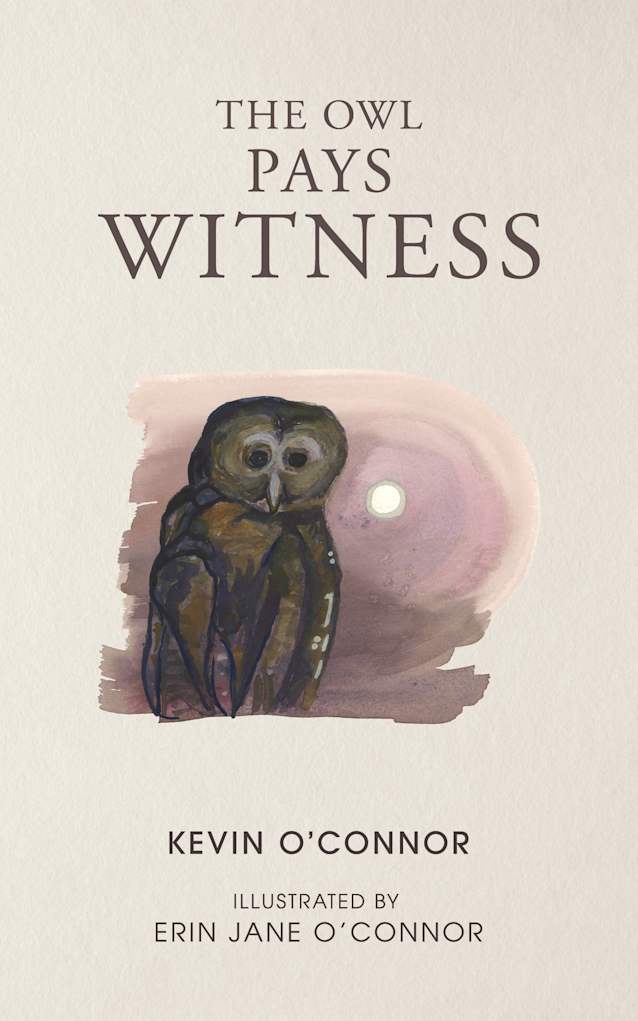
The Owl Pays Witness
About
Haiku—seventeen syllables that express the essence of a moment, a feeling, a sight. Poet Kevin O’Connor does this masterfully in The Owl Pays Witness.
Fall puts on her boots, a starling skims at dusk, an oak tree wears dragons in the shade. Meditate on these eighty-two reflections paired with the artwork of Erin O’Connor.
Witness what the owl sees.
Praise for this book
In their debut poetry collection, the O’Connors offer a gentle, reverent haiku collection, aligned with the form’s traditions, that celebrates even the most humble observations in nature, like “the oak and the pine—// old friends sharing memories, // one clothed and one bare.” In many of O’Connor’s poems, a profound message lies beneath the surface image; in the case of the oak and pine haiku, the trees are friends regardless of their differences—one deciduous and one evergreen—and their diversity is a source of joy. Other poems’ meanings burst forth as a result of their association with Erin Jane O’Connor’s illustrations.
For example, following this haiku that depicts an abandoned set of antlers, “antlers on the ground // that knew the rut and the scrape // of battles long past,” O’Connor’s watercolor is a hazy, somewhat forlorn still-life of pockmarked, battered antlers that signify a life mired in struggle. In some instances, the power of the artwork exceeds that of the poems, as with the gorgeous rendering of a fish head, which showcases O’Connor’s talent as a fine artist. Toeing the line between abstract and impressionist styles, with some striking assemblages thrown in, O’Connor makes a poetry collection into an earthen-hued gallery of serenity.
Though most of O’Connor’s poems concern the non-human phenomena of nature, some offer commentary on the relationship between humanity and its home: “Leaves are falling, // golden husks once ripe with hope // ’neath the foot of man.” Yet while people certainly assume the role of destroyer in the earth’s ecosystem, O’Connor also offers verses imbued with nuance regarding our connection with the natural world, like this melancholy scene, “A dying man’s room, // she prepared a dour vase // where fresh-cut flowers live.” In this poem, humanity and flowers both churn in the cycle of life and death, which gives life to life.
Takeaway: Compelling nature-minded haiku with rugged illustrations.
Great for fans of: William Scott Wilson’s “The Illustrated Book of Japanese Haiku” and Jane Hirshfield’s “The Heart of Haiku”.
Production grades
Cover: A
Design and typography: A
Illustrations: A
Editing: A
Marketing copy: A